The Gangs of St. Louis - Chapter 1: The Mad Irishmen cont.
I apologize...but I had this entire thing typed and then received a friggin' error!
So here goes:
No one's sure how it happened or even why, but Dinty Colbeck moved his whole operation to the county, St. Louis County that is, the suburbs. No historical data has been found in reference to the Rats movement, but it is rumored that Police Lieutenant Duley McDonald "convinced" Dinty to move. Again, no one is sure exactly what happened, but the move did take place.
The Egan Rats converted an old 11-room home on the 9400 block o f Olive into their own, personal hangout. Soon, the hangout would be called the Maxwellton Club.
As the Rats settled into their new digs, they began to terrorize their new neighborhood little by little until they took over the Maxwellton Race Track. The race track was an abandoned, defunct horse and motorcycle track located at St. Charles Rock Road and Pennsylvania Avenue.
The Rats used their defunct track as training grounds, so to say. They would shoot at tin cans, bottles and other assorted targets set on the old grandstand, while driving around the track. This was to improve their marksmanship (which I might add they needed, have there been in battles involving bloodshed yet?). All was well and good.
Unfortunately, the fun was cut short when the envious Hogans dynamited and leveled the Maxwellton. In the following two years, there were 20 or more murders that could be attributed to the rival gangs with neither gang having any intentions of conceding.
The turncoat, Greenberg, was being questioned outside Police Headquarters when Dinty Colbeck and Red Smith were arrested. Apparently, Greenberg gave just enough information for Colbeck's and Smith's arrests, and was let out the back door. As soon as Greenberg's feet hit the concrete outside the Police HQ, he was headed to New York to avoid his inevitable death of retaliation.
Since Greenberg was all the way up in New York by the time Dinty and Red were released, the Rats focused their attention on Jellyroll Hogan. In another bloodless battle, Hogan and his buddy, Humbert Costello, were driving along South Grand when three men shot at them from a passing car. Even though Hogan was able to fire back a shot or two, the fiasco ended with no bloodshed.
After the shooting incident on South Grand, Hogan informed the police of his suspected attackers. Shortly thereafter, police arrested Rats members Elmer Runge and Isodore "Izzy" Londe. Hogan was brought in to identify his attackers which is when he was known to have said, "Yeah, I'll identify them alright, next time I see them I'll identify them with my shotgun".
In 1923, the community begged the two gangs to call a truce for the sake of the city. The two rival gangs oliged for two whole months.
Sadly, the truce was ended when three Rats fired into a crowd trying to kill James Hogan (Jellyroll's brother). Ironically, Hogan wasn't even hit, but two other men were fatally wounded. In an unusual turn of events, Dinty announced his responsibility in the shooting and apologized for the outcome. Dinty was quoted as saying it was just "boyish spirits" at play.
Finally, in April 1923, the two gangs shifted to more lucrative criminal activity like robbing mail trucks full of negotiable bonds. Some of their criminal activity even ventured over to the "East Side". That's east of the Mississippi River in Illinois. But, plenty of activity still remained in St. Louis - we'll get to the East Side soon.
It was said that the Rats alone were responsible for 23 robberies from 1919 to 1924 (that's almost 5 robberies a year). A canary, by the name of Ray Renard, mentioned that the Rats obtained a grand total of something to the tune of $44,685,770! Can you believe it? That's a lot of money now, can you imagine what it would have been like almost 100 years ago? Amazing.
However, Renard's loose lips caused the cops to issue warrants for Dinty Colbeck, Chippy Robinson, Red Smith and six other Rats. All were convicted and sentenced to 25-year prison terms.
Dinty was sent to the federal penitentiary in Atlanta to cohabitate with a well-known gangster named Al Capone. They were, in fact, cell mates.
Mrs. Colbeck, who was taking Catholic Instructions from Monsignor Joseph O'Toole of Our Lady, Queen of Peach in Webster Groves, was having horrible nightmares about Dinty - seeing him shot. She subsequently asked the Monsignor to go visit Dinty since she was so worried. You see, she was so worried about him returning to the criminal lifestyle that landed him in prison in the first place and she was concerned he'd end up dead, another gang statistic.
The tough Monsignor agreed to help Mrs. Colbeck and traveled to Atlanta to visit with Dinty. Once the Monsignor arrived in Atlanta and met Al Capone, he made a point to tell Capone that he and Dinty weren't to form any partnerships. In reply to the Monsignor's orders, Capone quipped, "The hell we're not! We'll both be sprung in six months and I'm the one giving the orders around here."
Passively, the Monsignor turned his attention to Dinty. He remembers telling Dinty, "You should be grateful that in a few months you'll be a free man. You know that if you proceed with this foolish partnership your freedom will be of short duration. Forget it, Dinty. That's my advice to you." Then Monsignor turned to Capone and said, "The goes for you too, Al".
Apparently, the Monsignor's advice fell upon deaf ears. Dinty was released after serving 16 years and quickly tried to reinvent his business. He began to muscle in on the "East Side" gaming action. Although, to his detriment, he only became a nuisance.
At 10:30 pm on February 17, 1943, a dark sedan appeared from no where and started following Dinty's car across the McKinley Bridge. At Ninth Street and Destrehan, they overtook Dinty and retired the Rats' leader. He wasn't addorned with medals, a plaque or a gold watch, he was only given six .45 caliber submachine gun slugs. He was put to rest at St. Catherine's Church in 1943. Now, that's the type of party I'd like to skip when I retire. I'll take my plaque, thank you.
****I'll take this time to point you in the direction of some great information on "Kerry Patch", the neighborhood.
"Kerry Patch", known to its inhabitants as "The Patch" is the neighborhood that produced the first gangs in St. Louis. "The Patch" was named for Kerry county in southwestern Ireland and was the Irish Mecca of St. Louis. Unfortunately, at the expense of a rich and colorful history, "The Patch" was bulldozed in the late 1940's. A couple housing projects - Carr Square Village and Pruitt-Igoe - were razed on the old land of "The Patch".
For further, more detailed information on "The Patch, read this awesome and extremely informational website.
On to Chapter 2 next!

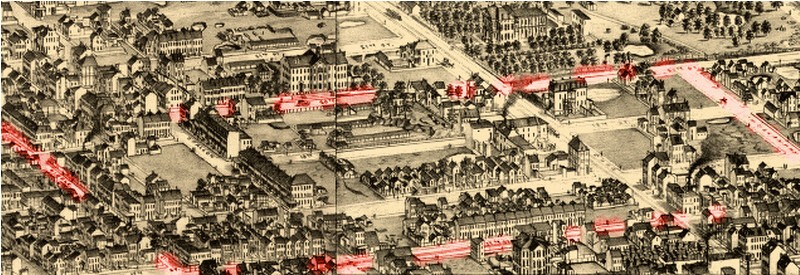

 When you think of gangs, the Mob or the Mafia, what cities come to mind? New York? Chicago? Los Angeles? Las Vegas? I'm going to go out on a limb and assume St. Louis isn't on the list of cities that you'd associate with "gangsters". If that were so, unfortunately, you'd miss out on an infamous history of gangs. St. Louis played an important role in the history of gang or mob activity.